Village of La Jolla
La Jolla
The Village is the walkable center of La Jolla: the blocks around Prospect Street and Girard Avenue, running down to the Cove and the coastline. It’s the one La Jolla neighborhood where most of the market is condos, with a La Jolla condo median of $1.22M year-to-date as of early 2026 and Village buildings ranging from the high $600Ks to well past $2M. Houses exist here. They’re rare, old, and fought over.
About the Village
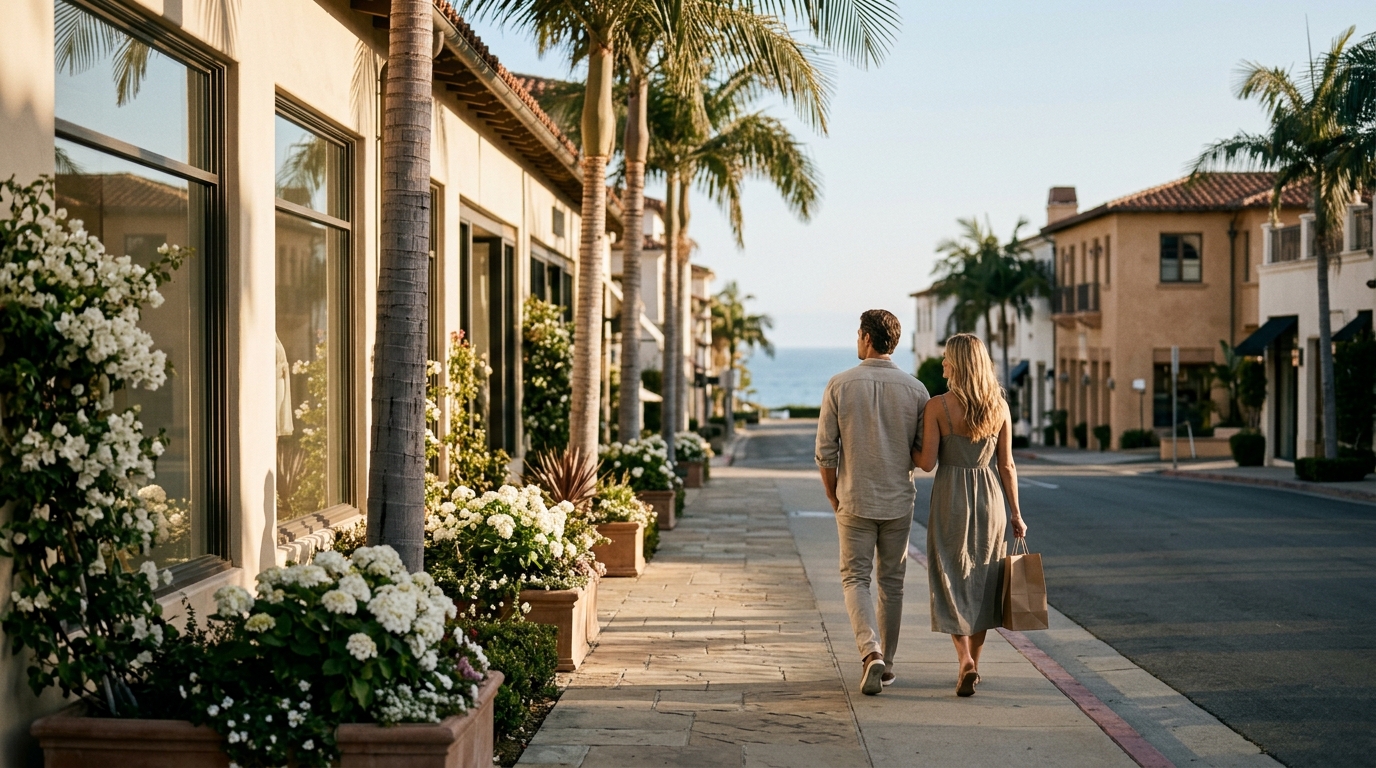
Every coastal town has a main street. The Village is La Jolla’s, except it’s twenty streets deep and it ends at an ecological reserve full of sea lions. Girard Avenue handles the everyday: Warwick’s, the bookstore that’s been at 7812 Girard since 1952 and holds the title of oldest continuously family-owned bookstore in the country, plus Harry’s Coffee Shop feeding actual residents breakfast since 1960. Prospect Street handles the show: galleries, valet stands, George’s at the Cove, Duke’s, and the NINE-TEN dining room. Two blocks further and you’re standing on the grass at Ellen Browning Scripps Park watching snorkelers work the Cove.
Living here means walking to nearly everything, which is rarer in San Diego than the sunshine makes you think. Residents do groceries, dinner, the pharmacy, and the ocean on foot. Many households quietly drop to one car. That’s the deal the Village offers, and the price of it is noise, summer congestion, and paying a premium per square foot for position rather than space.
Be clear-eyed about the congestion part. From June through Labor Day, and on any sunny weekend, the streets around the Cove fill with visitors, and getting a car out of the Village can take longer than the freeway leg of wherever you’re going. Villagers walk more, drive at odd hours, and guard their parking spot like it came with the deed. If you need a three-car garage and silence, look uphill at Mount Soledad or the Muirlands. If you want to live somewhere your out-of-town friends refuse to leave, this is it.
Who buys here: downsizers swapping a big house for a lock-and-leave condo near restaurants, professionals who want a walkable life without moving downtown, second-home buyers who visit often enough to skip hotels, and a steady stream of retirees who did the math on walkability and health and liked the answer.
Village of La Jolla real estate market
As of early 2026 (SDAR year-to-date figures through February):
| Metric | Figure |
|---|---|
| La Jolla condo and townhome median | $1.22M year-to-date (up 20.2% year over year) |
| Closed condo sales behind that number | 31 through February |
| Sale-to-list ratio, condos | 97.8% |
| Condo inventory | about 3.3 months of supply |
| Typical Village building range | high $600Ks to $2M+, view buildings past that |
Read the volume line before you trust the percentage line. A 20 percent year-over-year jump on 31 sales says less about your building than it does about which buildings happened to close that quarter. Ocean-view buildings on Coast Boulevard and Prospect price like small houses; interior-block buildings from the 1960s price like the entry ticket they are. I comp Village condos building by building, and inside larger buildings, stack by stack, because the fourth floor with a Cove view and the ground floor facing the parking structure are not the same purchase wearing the same address.
The rare detached homes are their own market: 1920s and 30s Spanish revival and storybook cottages on small lots, some with Mills Act historic-designation potential that can cut property taxes meaningfully for the right house. When one lists in decent condition, it draws everyone at once. Patience and pre-work win those, not enthusiasm.
The housing stock, and what I check
Most Village condo buildings went up in the 1960s and early 70s, before the 30-foot coastal height limit passed in 1972 and froze the skyline. That vote is why your view can’t be built out by a new tower, and also why the building you’re buying into is probably 55+ years old with the plumbing to match.
So on Village condos I read three things before my clients write:
The HOA’s financial health. Budget, reserve study, meeting minutes. Buildings this age face re-piping, elevator replacement, roofing, and facade work, and the difference between a funded reserve and a coming special assessment can be $40,000 of your money. A $900 monthly fee with real reserves beats a $600 fee hiding a $2M repipe.
Salt-air condition of the building envelope. Railings, window systems, exterior metal. The ocean is a block away and it never stops working. Deferred exterior maintenance in the minutes is tomorrow’s assessment.
Rental and use rules. Minimum lease terms, pet rules, and short-term rental positions vary sharply by association, and San Diego’s STRO license rules cap whole-home short-term rentals citywide anyway. If any part of your plan involves renting the condo, we verify the CC&Rs and the license math before you offer, not after. Owners selling out of an investment condo should also read my 1031 exchange guide before listing, because the 45-day clock forgives nobody.
Schools serving the Village
The public path is a genuine part of Village value, even though the condo-heavy market means fewer school-age households than the rest of La Jolla. GreatSchools ratings as of 2026:
- La Jolla Elementary rates a 9 and serves the Village and the beach tracts.
- Muirlands Middle rates a 9, up Nautilus Street.
- La Jolla High rates a 9, a short drive south of the Village core.
Boundaries are address-specific, so I confirm the feeder assignment on any specific home before a family counts on it.
Amenities and lifestyle
- La Jolla Cove: the postcard, one block from Prospect. Snorkelers, sea lions, and the clearest water in the county inside the ecological reserve.
- Ellen Browning Scripps Park: the grass bluff above the Cove. Sunset here is the neighborhood’s shared ritual.
- Girard Avenue: the errand street. Warwick’s for books, a hardware store, and the kind of small shops that make a town function.
- Harry’s Coffee Shop: on Girard since 1960. Where residents eat breakfast while visitors wait in line somewhere else.
- George’s at the Cove: the Prospect Street anchor. The ocean terrace is where out-of-town buyers decide they’re moving here.
- Duke’s La Jolla: the easier Prospect option, Hawaiian-leaning, with the same ocean out the window.
- NINE-TEN: the fine-dining room on Prospect for the anniversary calendar.
- Children’s Pool: the seawall beach a few blocks south where the seals haul out. Contentious among locals for decades, beloved by everyone’s visiting relatives.
How I run a Village purchase
Condo diligence is document work, and I actually do it. Before my clients offer, I read the HOA budget, reserve study, and the last year of minutes, and I ask the manager the questions sellers hope nobody asks: pending assessments, litigation, insurance renewals, plumbing history. On the building itself I bring my construction read to the envelope and the systems, because at 60 years old the building is the purchase and the condo is just your slice of it. Then we price against the right comp set: same building where possible, same view tier where not. That last part matters more in the Village than anywhere in La Jolla, because portal estimates average view condos against alley condos and produce a number that describes neither.
For the rare detached cottages, speed and preparation replace patience. We set the walk-away number before the tour, verify Mills Act status and permit history the same day, and write clean. Those houses don’t wait, and neither do the buyers who lose them twice.
Why buyers choose the Village
It’s the only place in San Diego that combines a real walkable town center with a world-class coastline at the end of the block. You give up square footage, garage space, and summer quiet. You gain a life where the car stays parked, and a home protected by a height limit that guarantees nobody builds a bigger Village. Buyers who want sand under their feet instead of restaurants should look at La Jolla Shores; buyers who want a house and a surf break should walk south to Windansea.
Frequently asked questions
How much does a condo cost in the Village of La Jolla? La Jolla condos ran a $1.22M year-to-date median as of early 2026, up 20.2% on thin volume. Village buildings span roughly the high $600Ks for older interior-block homes to $2M and beyond for ocean-view buildings on Coast Boulevard and Prospect.
Are there houses in the Village of La Jolla? A few, and they rarely last. Mostly 1920s and 30s Spanish revival and storybook cottages on small lots, some with Mills Act potential that can lower property taxes for designated historic homes. When a sound one lists, prepared buyers win it.
Is the Village of La Jolla walkable? The most walkable neighborhood in coastal San Diego. Groceries, restaurants, the pharmacy, the bookstore, and the Cove are all on foot from most addresses, and many residents drop to one car.
What should I check before buying a Village condo? The HOA’s reserves and minutes first, because most buildings predate 1972 and big systems come due at this age. Then the building envelope for salt-air wear, then the rental and use rules if you ever plan to lease it. I do all three before clients write.
Is a Village condo a good investment? As a long hold, the supply story is strong: the 30-foot height limit means no new competing towers, ever. As a cash-flow rental, the math is tight at these prices and HOA fees, and short-term rental rules limit the aggressive strategies. Buy it to live in or hold long, not to chase yield.
Find your home in the Village
Tell me your budget and what you’re walking to, and I’ll send you the buildings worth your time, with my read on each HOA attached. Call or text (619) 568-2649 or send a message. Back to the full La Jolla guide, or compare with La Jolla Shores and Windansea.