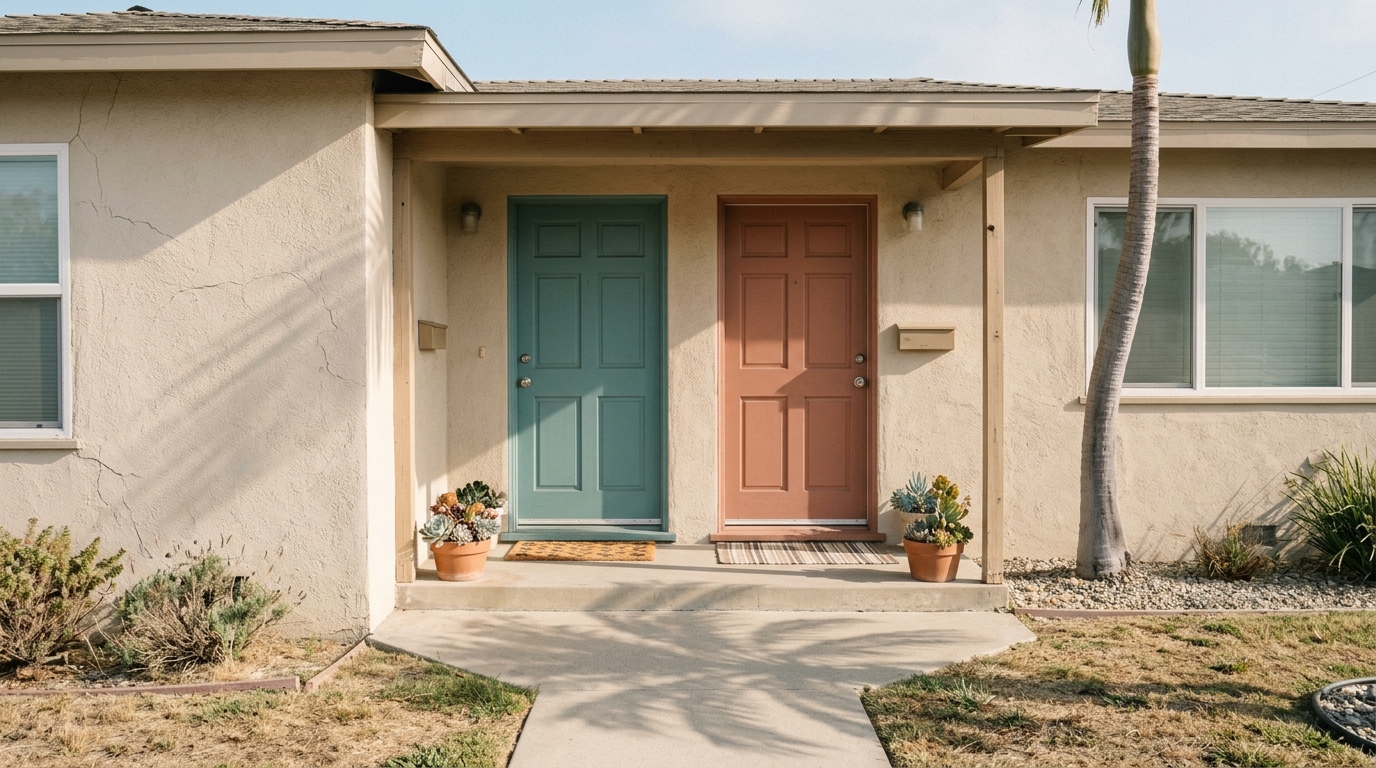
Buying a Duplex or 2-4 Units in San Diego
A 2-4 unit property is the best first purchase most San Diego buyers never consider. It finances like a house, not a commercial building, and living in one unit while renting the others can cut your housing cost by more than half. Citywide, small multifamily lists around a $1.5M median with roughly 334 active listings as of mid-2026. Here’s how the strategy works and where the numbers hold up.
Why 2-4 units is the sweet spot
The financing world draws a bright line at four. Properties with one to four units qualify for residential mortgages: thirty-year fixed terms, the loan products you already know, underwriting based largely on you. At five units the property becomes commercial, with shorter terms, bigger down payments, and underwriting based on the building’s income. A fourplex is the largest rental property you can buy with a regular home loan, which makes it the most powerful square footage in real estate for a normal household.
There’s a second advantage that matters just as much in an expensive city: lenders count a portion of the expected rent from the other units toward your qualifying income. Buyers who can’t qualify for a $1.5M house on their salary alone sometimes can qualify for a $1.5M duplex, because the property helps carry itself. Every lender runs this differently, so the first phone call is to one who actually closes 2-4 unit loans, not whoever did your last refinance.
The catch, and I’ll keep repeating it: San Diego is a low-yield market. Cap rates on small multifamily run about 4.5 to 5 percent, and buildings rarely cover their own full mortgage at today’s prices with 25 percent down. The strategies below work because of owner-occupancy, rent growth over time, and vacancy that has held between 4 and 5 percent for more than fifteen years. They don’t work as spreadsheet-perfect cash flow on day one. Anyone promising that here is selling something.
House hacking, in plain numbers
House hacking means buying a 2-4 unit property, living in one unit, and renting the rest. Because you live there, you buy with an owner-occupied loan, and that changes everything about the entry cost.
A standard investment loan on a rental wants 20 to 25 percent down. On a $1.5M property that’s $300,000 to $375,000 in cash. Owner-occupied programs run dramatically lower: FHA allows as little as 3.5 percent down on 2-4 units, and conventional owner-occupied options on small multifamily have gotten far friendlier in recent years. Programs and limits change, so treat the exact percentages as a lender conversation, but the principle is stable: occupancy is worth six figures of down payment in this market.
Two honest wrinkles. First, FHA loan limits and its self-sufficiency test on triplexes and fourplexes (the rents have to cover the payment on paper) knock out many high-priced San Diego properties, which is why most local house hacks end up on duplexes or on conventional financing. Your lender will know within a day which lane you’re in. Second, owner-occupied loans require you to actually move in and stay a while, typically a year. This is a lifestyle decision as much as a financial one.
What you get for it: the tenants’ rent offsets most of your payment, you learn landlording with your manager living on site (you), and after the occupancy period you can move out, rent your old unit, and do it again. I’ve watched this two-purchase sequence build more net worth for young buyers than a decade of saving for a detached house would have. That’s the opinion part of this page, and I hold it strongly: if you’re under 40, open to sharing a lot line, and trying to get a foothold in this market, house hacking a duplex beats waiting for a single-family price you’ll qualify for “next year.”
Where the numbers work
Small multifamily clusters in specific pockets here, and the pocket decides the tenant, the rent, and the headache level.
- Pacific Beach: the strongest rental demand in the city, at the highest prices, around $920 per square foot as of Q3 2026. Duplexes and cottage clusters east of the boardwalk draw young professionals who pay reliably and move often. You’ll pay retail. PB rents forgive it over time.
- Ocean Beach: 82.6 percent of residents rent, which is the whole thesis in one number. Older duplexes and fourplexes come up regularly, tenants stay for years, and the buildings are usually as old as the town’s attitude. Inspect accordingly.
- Clairemont and Bay Park: fewer true multifamily properties, but the house-plus-ADU configuration is functionally a duplex, often at a better price per door. If that route fits you, the ADU guide is the companion read.
- North Park, City Heights, and points east: more buildings, lower prices, stronger paper cash flow, more management. Outside my core turf, and I say so, but plenty of my clients start there and move toward the coast later with a 1031 exchange.
One number to carry into every showing: GRM, the price divided by yearly rent. A $1.5M duplex collecting $84,000 a year runs a GRM of 17.9. Central San Diego mostly sells in the mid-to-high teens; meaningfully lower deserves a same-day look and a suspicious read of the leases. It’s a blunt tool, but it sorts a Zillow session fast.
Rent control and tenant law, before you fall in love
California’s AB 1482 caps annual rent increases on most multifamily buildings more than 15 years old and adds just-cause eviction rules. For a San Diego 2-4 unit buyer, that means three practical things.
You buy the rent roll, not the projection. If the long-term tenant in unit B pays $1,800 against a “market rent” of $2,900, the law limits how fast that gap closes, and it may not close while they stay. Underwrite the actual leases.
Owner-occupied duplexes get a carve-out. Under current rules, a duplex where the owner lives in one unit is generally exempt from AB 1482’s caps, which quietly makes the house-hacked duplex one of the most flexible small rentals in California. Verify your exact situation before relying on it; exemptions have conditions and the law gets amended.
Inherited tenants deserve a plan, not a fantasy. Buying occupied buildings “and raising rents to market” is a strategy people describe at meetups and regret in practice. I’d rather negotiate price off the real income than have you budget on evictions.
What I check before you offer
The inspection window is where these deals are won, and small multifamily has its own checklist on top of the usual one:
- Actual leases, deposits, and estoppels. Every tenant confirms in writing what they pay and what they’re owed. Listing rent rolls are marketing until proven otherwise.
- Sewer and panel. Most of this stock is 1950s to 1970s. One clay sewer lateral serving four kitchens fails harder than one serving one. A few hundred dollars of scoping has clawed back five-figure credits for my buyers more than once.
- Permit history on every unit. San Diego is full of “triplexes” that are legally duplexes with a converted garage. Unpermitted units can’t be counted by your lender, may not be insurable, and price like liability, not income.
- Meters and utilities. Separately metered gas and electric changes your monthly math and your tenant relationships. Master-metered buildings mean you’re the utility company.
- Short-term rental assumptions. Whole-home STRO licenses are capped citywide with a larger carve-out only in Mission Beach. If the listing’s numbers need nightly rates, they need a license you may never get. Underwrite long-term rents or walk.
The traps
The pro forma building. Projected rents, understated expenses, a cap rate that evaporates when you plug in real numbers. Covered above, but it’s the trap that eats the most first-time buyers, so it gets named twice.
The phantom unit. That unpermitted studio behind the garage is not a unit. It’s a demolition order with a tenant in it. Price the property as if it isn’t there, because one code complaint and it isn’t.
Deferred maintenance multiplied. A tired single-family house has one roof and one water heater. A tired fourplex has one roof and four of everything else. Reserve accordingly, even if you’ll self-manage.
Buying yield you can’t collect. The listing that pencils beautifully in a rough pocket you’d never visit at night pencils differently after your third turnover year. Drive the block at 9 pm before you write.
Frequently asked questions
How much do I need to put down on a duplex in San Diego? If you’ll live in one unit, owner-occupied programs start as low as 3.5 percent down with FHA, subject to loan limits and property qualification. Pure investment purchases generally want 20 to 25 percent. Exact numbers move with programs, so start with a lender who closes 2-4 unit loans.
Is house hacking worth it in San Diego? Yes, more than almost anywhere, because the gap between owning and renting is so wide here. Tenants covering most of your payment turns an impossible monthly cost into a manageable one, and vacancy has stayed between 4 and 5 percent for over fifteen years, so the rental side is dependable.
Does rent control apply to a duplex? Often not, if you live there. AB 1482 caps rent increases on most multifamily buildings over 15 years old, but an owner-occupied duplex is generally exempt under current rules. Non-owner-occupied buildings should be underwritten with the caps in mind. Confirm your specific case before you rely on an exemption.
Where is the best place to buy a duplex in San Diego? Pacific Beach and Ocean Beach have the deepest small-multifamily stock and the strongest tenant demand near the coast. Clairemont’s house-plus-ADU setups compete on price per door. Neighborhoods east of the 163 offer lower prices and higher paper yields with more management effort.
Can I buy a fourplex with an FHA loan in San Diego? Sometimes, but FHA’s self-sufficiency test requires a triplex or fourplex’s rents to cover the payment on paper, and many high-priced San Diego buildings fail it. That’s why most local house hacks land on duplexes or conventional owner-occupied financing. A good lender sorts this in one conversation.
Want the real numbers on a building?
Send me a listing, or just your budget and the neighborhoods you’d actually live in, and I’ll send back the honest version: real rents, the GRM against recent sales, what the leases likely hide, and whether the seller’s numbers survive contact with a calculator. I invest here myself and I’d rather kill a bad deal in a text message than in your escrow. Call or text (619) 568-2649 or send a message. For the broader market picture, start with the investment property guide or browse the resources hub.
Related Resources
San Diego Investment Property Guide
How to buy rental property in San Diego: cap rates near 5%, vacancy under 5% for 15 years, and where the numbers still…
Read Guide →San Diego ADU Guide 2026
San Diego ADU rules changed in 2025 and 2026.
Read Guide →1031 Exchange in San Diego
The 45-day and 180-day deadlines, California's clawback rule, and how San Diego investors actually use 1031 exchanges.
Read Guide →