Measurable Case Studies: ADU Additions Property Value Impact in San Diego
Navigating the San Diego real estate market requires an understanding of how to maximize every square foot of your investment. Over the past few years, we have seen a massive surge in homeowners building Accessory Dwelling Units to generate rental income and accommodate growing families. If you are considering this path, you likely want to know about the tangible, measurable impact of ADU additions property value before breaking ground. Building an ADU is a significant financial commitment, but when executed correctly, it can drastically transform your financial future and property equity.
As part of Adam King Real Estate Strategies, my priority is ensuring you feel confident and clear on every decision we make together. We have compiled data-backed evaluations of local properties that added these secondary units. This comprehensive guide will break down the construction costs versus the overall property equity gained, giving you a transparent look at what you can expect.
Table of Contents
- Understanding How ADU Additions Property Value Grows
- Case Study 1: Transforming a Clairemont Mesa East Backyard
- Case Study 2: Maximizing Space and Equity in Point Loma
- Case Study 3: A Multi-Generational Build in Bay Park
- Data Comparison: Construction Costs vs. Equity Gained
- Financing Your Accessory Dwelling Unit
- Frequently Asked Questions (FAQ)
Understanding How ADU Additions Property Value Grows
Adding an ADU to your property is essentially creating a brand new, income-producing asset right in your backyard. Unlike traditional home renovations that only offer a percentage of their cost back in equity, ADUs often provide a one-to-one or even a positive return on investment. The key driver of this growth is the income potential, as appraisers increasingly use the income approach to value properties with legally permitted secondary units. This means the predictable rental income directly elevates the baseline valuation of your entire parcel.
In the highly competitive San Diego market, inventory remains incredibly tight, and livable square footage is at a premium. Buyers are willing to pay a significant premium for properties that offer immediate rental income to offset their mortgage costs. Furthermore, the flexibility of housing aging parents or adult children without purchasing a second home is a massive selling point. This dual utility makes homes with ADUs highly sought after, driving up competitive bidding when it comes time to sell.
Case Study 1: Transforming a Clairemont Mesa East Backyard
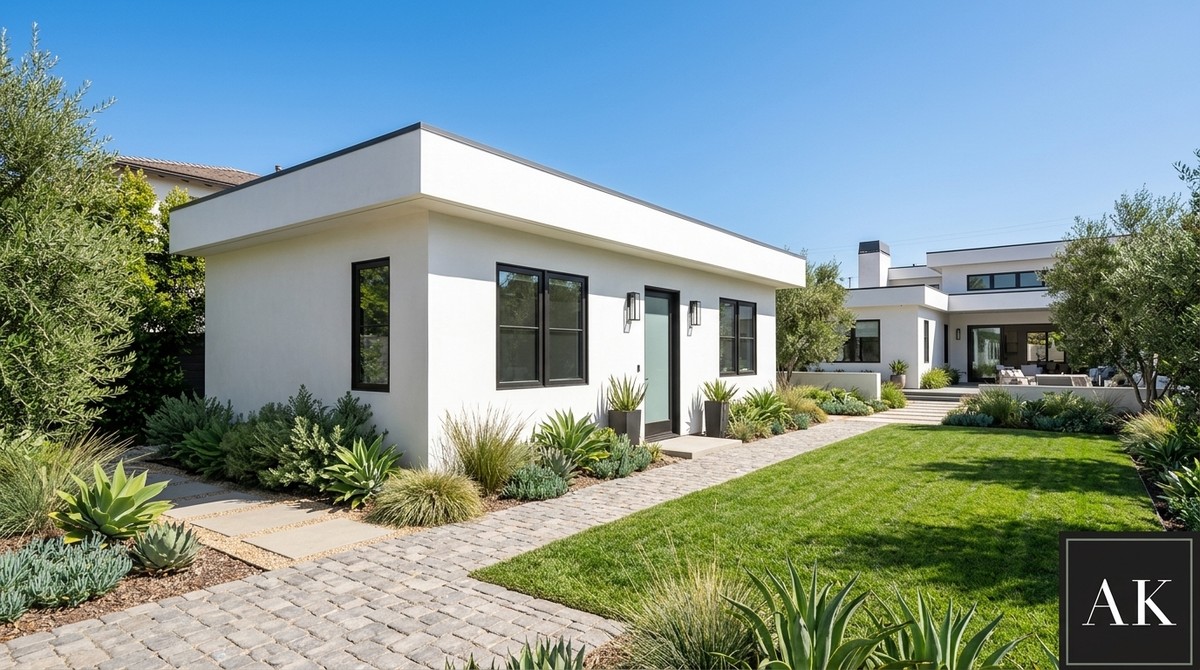
Our first evaluation takes us to a classic single-family home on a spacious, flat lot. The homeowners wanted to capitalize on their unused backyard space to create a reliable revenue stream. After evaluating several Clairemont Mesa East properties, they realized that adding a detached, two-bedroom unit would yield the highest return. They designed an 800-square-foot structure with a private entrance and dedicated outdoor space to maximize tenant privacy.
The total construction cost for this ground-up build came in at roughly $240,000, which included all permitting, utility trenching, and mid-range finishes. Before the addition, the primary residence appraised at $850,000 based on recent neighborhood comparables. After the ADU was completed and fully permitted, a new appraisal was ordered to refinance their construction loan into a long-term fixed mortgage.
The results were incredibly validating for the homeowners’ investment strategy. The post-construction appraisal valued the property at $1,150,000, representing a gross equity increase of $300,000. Not only did they immediately recoup their entire construction cost in equity, but they also netted an additional $60,000 in immediate property value. Moreover, the unit now rents for $2,800 per month, completely covering their refinanced loan costs and providing substantial positive cash flow.
Case Study 2: Maximizing Space and Equity in Point Loma
Coastal properties often present unique challenges regarding lot size and strict zoning regulations, but they also offer massive upside potential. A client with a historic home decided to convert an existing detached two-car garage into a one-bedroom rental unit. Because they were utilizing an existing structure, the project fell under different permitting guidelines and avoided the massive costs associated with a new foundation and framing. Researching Point Loma real estate trends revealed a severe shortage of high-quality, single-occupancy long-term rentals.
This conversion was an exercise in efficiency, keeping the total project cost down to an impressive $135,000. The budget focused heavily on soundproofing, high-end interior finishes, and clever storage solutions to make the 450-square-foot space feel luxurious. The primary home’s original valuation was $1,400,000 prior to the start of the renovation project.
Upon completion, the property’s value surged to $1,625,000. This $225,000 jump in equity was driven largely by the high demand for rental units in premium coastal neighborhoods. The homeowners achieved an outstanding return on investment, gaining $90,000 in pure equity above their construction costs. They currently rent the unit to a traveling nurse for $2,400 per month, solidifying their financial stability while owning a premier coastal asset.
Case Study 3: A Multi-Generational Build in Bay Park
Not every ADU project is driven strictly by rental income; many families build these units to keep loved ones close while maintaining independence. A family looking at Bay Park neighborhoods opted to build a custom 600-square-foot detached unit for aging parents. Their primary goal was accessibility and comfort, which meant investing heavily in zero-threshold showers, wider doorways, and premium insulation for temperature control.
The specialized construction requirements brought their total investment to $210,000. While the primary motivation was family use rather than market rent, we still wanted to track the impact on their overall portfolio. The home originally appraised at $1,100,000 before the ground was broken for the new foundation.
Once the project wrapped up, the final appraisal came in at $1,325,000. Even without a signed lease agreement in place to prove income, the added livable square footage and the high quality of the build added $225,000 to the property value. This essentially means the family built a custom home for their parents at virtually zero net cost to their overall net worth, proving that ADUs are a powerful tool for wealth preservation.
Data Comparison: Construction Costs vs. Equity Gained
To provide a clear, easy-to-follow flow of our findings, we have summarized the case studies into a direct comparison. This data highlights the consistent correlation between the capital invested and the immediate appraisal boost across different San Diego neighborhoods. The numbers speak for themselves regarding the viability of this strategy.
| Neighborhood (Project Type) | Starting Value | Construction Cost | Final Appraised Value | Net Equity Gain (Value – Cost) |
|---|---|---|---|---|
| Clairemont Mesa East (Detached Build) | $850,000 | $240,000 | $1,150,000 | +$60,000 |
| Point Loma (Garage Conversion) | $1,400,000 | $135,000 | $1,625,000 | +$90,000 |
| Bay Park (Accessible Detached Build) | $1,100,000 | $210,000 | $1,325,000 | +$15,000 |
As the table demonstrates, every single project resulted in a positive net equity gain immediately upon completion. While construction costs certainly vary based on finish quality and site conditions, the resulting property value increases consistently outpaced the initial out-of-pocket expenses. This is a testament to the strong demand for secondary units in our local market.
Financing Your Accessory Dwelling Unit
Understanding the costs and the potential gains is only half the battle; figuring out how to fund the project is where many homeowners get stuck. Fortunately, the financial industry has recognized the value of ADUs and developed specific loan products to help you succeed. One of the most popular methods is utilizing a Home Equity Line of Credit (HELOC), which allows you to borrow against the existing equity in your primary residence without touching your current first mortgage.
Another excellent option is a cash-out refinance, assuming your current interest rate makes sense for a full loan replacement. More recently, renovation loans and specialized ADU construction loans have entered the market, allowing you to borrow against the future appraised value of the home once the unit is complete. We always recommend speaking with a trusted local lender to determine which financial vehicle aligns best with your long-term investment goals.
Frequently Asked Questions (FAQ)
Do ADUs trigger a full property reassessment for property taxes?
A common concern among homeowners is whether building an ADU will cause their entire property to be reassessed, potentially skyrocketing their property tax bill. In California, under current laws, adding an ADU only triggers a blended reassessment. This means your primary residence retains its original Proposition 13 tax base, and only the newly constructed value of the ADU is assessed and added to your existing tax bill.
How long does the permitting and construction process typically take?
The timeline can vary wildly depending on the complexity of your design and the specific municipality you are building in. Generally, you should expect the design and permitting phase to take anywhere from three to six months. Once permits are issued, actual construction typically takes an additional four to eight months, making it a roughly year-long commitment from concept to final inspection.
Will an ADU limit my pool of potential buyers if I decide to sell?
Based on current market data and buyer behavior, having a well-designed ADU actually expands your buyer pool rather than limiting it. Buyers are actively seeking properties with income potential to help offset higher interest rates and purchase prices. Additionally, multi-generational families represent a huge segment of the market that exclusively looks for properties with separate living quarters.
Can I build an ADU if my property is governed by a Homeowners Association (HOA)?
Yes, recent state legislation in California has made it incredibly difficult for HOAs to outright ban the construction of ADUs or Junior ADUs. While an HOA can still impose reasonable aesthetic guidelines to ensure the new structure matches the neighborhood, they cannot enforce rules that effectively prohibit the build or make it financially unfeasible.
Ready to Maximize Your Property’s Potential?
The numbers clearly show that investing in your own backyard is one of the smartest real estate moves you can make today. Whether you want to generate passive income or create a comfortable space for family members, the financial returns are highly compelling. The process requires careful planning and local expertise, but the long-term rewards for your family’s wealth are undeniable.
If you are ready to explore how an ADU could transform your specific property, I am here to provide honest guidance and accurate pricing insights. Let’s look at the data for your neighborhood together and craft a strategy that works for you. Take the next step and schedule a consultation with Adam King Real Estate Strategies today to secure your financial future.