San Diego Multifamily Investing: The $5K Cash Case Study
Recently on my YouTube channel, I shared a breakdown of a real-world scenario that generated a massive amount of questions from our viewers. The video detailed how a buyer could successfully navigate San Diego multifamily investing and ultimately own a lucrative property with approximately $5,000 of their own cash remaining in the deal. Because that specific number sounds almost too good to be true, I want to unpack the exact mechanics of how this strategy works in practice. This is an anonymous case study based on a real-world example, designed to show you exactly how the math and the method come together.
Let me be absolutely clear right out of the gate about the $5,000 claim. You cannot purchase or close on a multifamily property in this market with only five thousand dollars. The buyer needs substantially more cash to initially acquire the asset and execute the necessary improvement strategy. The $5,000 figure represents the estimated net cash left invested in the property at the very end of the entire process. This happens only after completing significant renovations and executing a carefully planned cash-out refinance.
Here at Adam King Real Estate Strategies, I always emphasize that sophisticated investing is not simply about buying a cheap property. It is about understanding acquisition, value creation, financing, income, and capital recycling as one unified strategy. When you approach the market with this holistic view, you unlock opportunities that average buyers completely overlook. Let us walk through this specific strategy chronologically to see exactly how the numbers pencil out for a savvy investor.
Understanding the Strategic Foundation
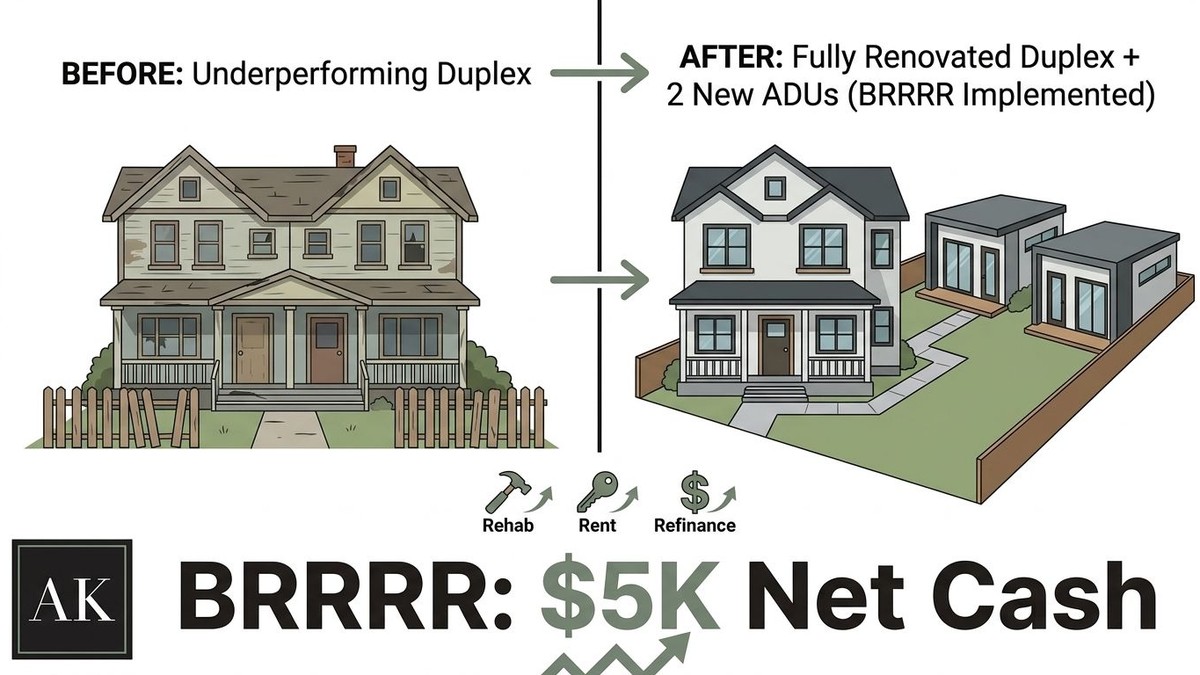
The core concept we are discussing is often referred to in the investing community as the BRRRR method, which stands for Buy, Rehab, Rent, Refinance, and Repeat. While the acronym is popular, executing it successfully in a high-cost coastal market requires extreme precision. You have to find a property with clear upside potential and manage construction costs aggressively. If you miscalculate your renovation budget or overestimate your final appraisal, your capital could easily get trapped in the deal.
For this case study, we will look at a classic local scenario involving an underperforming duplex. The property was in a highly desirable neighborhood but suffered from years of deferred maintenance and poor management. The lot was exceptionally large, which immediately signaled an opportunity for additional development under current California accessory dwelling unit regulations. Recognizing this hidden potential is the very first step in executing a successful capital recovery strategy.
Step One: The Acquisition Strategy
The buyer located a tired duplex listed for $1,200,000 in a strong rental corridor. To make this deal work, they needed a conventional investment loan requiring a 25 percent down payment. This means the loan amount from the acquisition lender was $900,000. Finding a property with the right zoning and lot size is crucial when your plan involves major expansion.
Many investors focus entirely on turnkey properties, but those rarely offer the equity spread needed for this strategy. The ideal target is a property that scares away retail buyers but has fundamentally good bones. Neighborhoods with strong renter demand, much like the Clairemont neighborhoods, are perfect for this approach. You want areas where newly renovated units command a premium price.
Step Two: Initial Capital Requirements
This is where we address the reality of the initial cash required to play this game. The buyer had to bring a 25 percent down payment of $300,000 to the closing table. In addition to the down payment, they paid roughly $30,000 in closing costs, loan fees, and initial holding reserves. Right from day one, the buyer had $330,000 of their own capital deployed into this asset.
Furthermore, the strategy required a massive renovation and development budget. The plan included fully remodeling the two existing units and constructing two brand new detached ADUs in the spacious backyard. The estimated cost for this entire construction phase was $250,000, which the buyer funded entirely in cash to avoid high-interest hard money loans. By the time the dust settled on construction, the buyer had invested a total of $580,000 out of pocket.
Step Three: Value Creation and Development
Value creation is the engine that drives this entire real estate strategy forward. The buyer spent six months meticulously managing contractors to update the original duplex with modern kitchens, luxury vinyl plank flooring, and in-unit laundry. Simultaneously, construction crews trenched utilities and poured foundations for the two new ADUs. This process transformed a decaying two-unit property into a highly desirable four-unit cash flowing machine.
This phase requires intense project management and a deep understanding of local permitting processes. Delays cost money in the form of carrying costs, property taxes, and insurance payments. However, by adding two legally permitted units to the parcel, the buyer forced massive appreciation that goes far beyond simple market inflation.
Step Four: Stabilization and Income Generation
Once construction wrapped up, the next critical step was stabilization through aggressive leasing. A property is considered stabilized when all units are rented at market rates and operating smoothly. The newly renovated front units rented for $3,200 each, while the brand new ADUs commanded $2,800 each. This generated a gross monthly income of $12,000, fundamentally changing the financial profile of the asset.
Achieving top-tier rents requires delivering a high-quality product that appeals to modern tenants. We see this dynamic constantly in highly competitive areas like the Pacific Beach rental market, where premium finishes attract premium renters. Strong, documented rental income is the exact metric the banks will look at during the next phase of the strategy. You cannot successfully refinance without proving the income.
Step Five: The Cash-Out Refinance
With the property fully leased and generating robust income, the buyer approached a lender for a cash-out refinance. Because the property now consisted of four legally permitted units, it was appraised based on a blend of residential comparable sales and income generation. Thanks to the extensive upgrades and the addition of the ADUs, the new appraised value came in at a staggering $2,000,000. This newly created equity is what makes the magic happen.
The lender offered a new 30-year fixed loan at a 75 percent loan-to-value ratio based on the new appraisal. This means the new loan amount was approved for $1,500,000. The original acquisition loan of $900,000 was still sitting on the property and needed to be addressed. The refinance process essentially replaces the old debt with the new, larger debt facility.
Step Six: Capital Recovery and Net Cash Remaining
Now we finally get to the math that explains the $5,000 claim from the beginning of this case study. The new loan provided $1,500,000, and the very first thing it did was pay off the original $900,000 acquisition loan. This left $600,000 in gross proceeds available to be distributed back to the buyer. After accounting for roughly $25,000 in new loan fees and closing costs, the buyer received a wire transfer for $575,000.
Let us look closely at the net cash position after that wire transfer cleared the bank. The buyer originally invested $580,000 of their own cash between the down payment, closing costs, and construction budget. By pulling $575,000 back out tax-free through the refinance, their net remaining capital in the deal is exactly $5,000. They now own a cash-flowing, four-unit, two-million-dollar asset with virtually none of their original money tied up.
The Long-Term Strategy: Redeploying Capital
The beauty of this approach is what happens to that $575,000 the buyer just recovered. Because refinance proceeds are considered debt rather than income, this money is entirely tax-free capital. The buyer can now take that exact same pool of funds and use it as the down payment and renovation budget for their next project. This is how sophisticated investors scale their portfolios rapidly without constantly needing to save new money from their day jobs.
Meanwhile, the stabilized four-unit property continues to operate in the background. The $12,000 in monthly rental income covers the new, larger mortgage payment, property taxes, insurance, and maintenance reserves. The buyer enjoys debt paydown, long-term appreciation, and tax benefits, all while retaining their original investment capital to grow their wealth elsewhere.
Risks, Variables, and Market Realities
While the numbers in this case study are compelling, it is crucial to understand the substantial risks involved. Construction costs can easily spiral out of control if you uncover plumbing or foundation issues behind the walls. Municipal permitting timelines can drag on for months, significantly increasing your holding costs before you can collect a single dollar of rent. If you are inexperienced with project management, a simple renovation can quickly turn into a financial nightmare.
Interest rates and market conditions are also massive variables that can change the outcome entirely. If interest rates spike during your renovation phase, your refinance terms might be much less favorable than you projected. A higher interest rate lowers your cash flow and can negatively impact the final appraised value of the building. Furthermore, lenders can suddenly change their loan-to-value requirements, meaning they might only allow you to pull out 70 percent instead of 75 percent.
You must also factor in operating realities like unexpected vacancies, tenant disputes, and routine maintenance costs. The projected $5,000 remaining investment is an illustration based on the specific assumptions of this case study, not a guaranteed result for every transaction. If the property appraises for less than expected, you could easily end up leaving $100,000 or more of your capital trapped in the deal. Conservative underwriting and significant cash reserves are absolutely mandatory.
The Bottom Line on Creating Value
This case study is not a story about finding a magical loophole to buy real estate for next to nothing. It is a masterclass in how a buyer can acquire an asset, execute a vision to create additional value, and use strategic financing to recover their initial capital. Real estate rewards those who are willing to do the hard work of solving problems that other buyers avoid. When you successfully navigate the complexities of development and financing, the financial rewards can be life-changing.
If you are ready to explore how these strategies might work for your own investment goals, you need a dedicated partner in your corner. Navigating these complex transactions requires deep local market knowledge, accurate pricing models, and steady negotiation skills. I am here to help you analyze the numbers, mitigate your risks, and build lasting wealth with complete confidence. 🏠
Frequently Asked Questions
Can You Own San Diego Multifamily With Just $5K Invested?
Potentially, but that is not the amount needed to buy the property. In this case study, the investor puts significantly more money in upfront and then recovers most of that capital through a cash-out refinance after creating additional value.
What does “$5,000 left in the deal” mean?
It means that after purchasing, improving, stabilizing, and refinancing the property, the investor has recovered most of their original investment while continuing to own the property.
How does the investor create enough value to refinance?
The strategy combines renovating the existing property, adding additional units, and increasing rental income. The goal is to create more value than the improvements cost.
Is this the same as the BRRRR strategy?
Yes, it’s a variation of Buy, Rehab, Rent, Refinance, Repeat (BRRRR), with development and ADUs playing a larger role in creating value.
Can this strategy work with other San Diego properties?
Potentially, but not every property is a good candidate. The purchase price, development potential, construction costs, rents, financing, and projected value all need to work together. The key is identifying that opportunity before you buy.